Allora has launched triple-barrier forecasts for Gold, Silver, and Oil on Forge testnet, our platform for building and running prediction models.
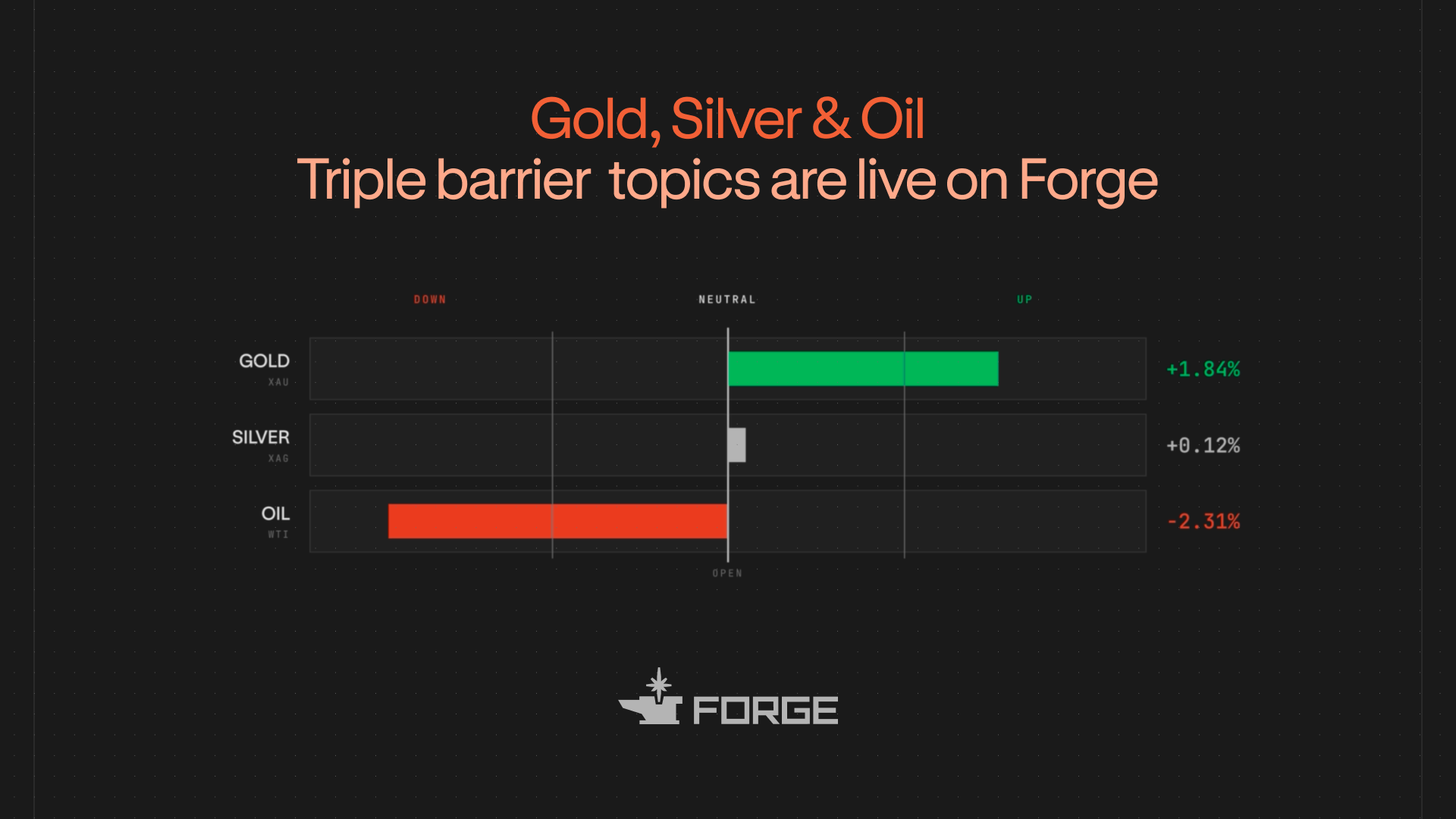
The launch brings structured predictive intelligence to three major real-world commodity markets. Each topic defines a forecasting task over a fixed window: whether the market reaches an upper threshold first, a lower threshold first, or neither before the window closes.
Independent ML models submit probabilities across those three outcomes. Allora synthesizes the submissions label by label into one network distribution that applications can consume.
For builders, the launch introduces three new commodity-market modeling surfaces with explicit targets and scoring loops. For enterprises, it provides a consistent signal that can feed existing risk, monitoring, and asset-management systems.
Predictive intelligence for RWA markets
Most RWA infrastructure focuses on representing ownership, moving assets, or settling transactions onchain. Those systems still need intelligence about the markets underneath the assets.
The Gold, Silver, and Oil topics address that prediction layer. Each one turns a commodity market into a bounded classification task and returns a network distribution that an application can use alongside existing market data and operating controls.
Allora is not tokenizing, holding, or settling the underlying commodities. The network predicts how a defined market window may resolve. The consuming application decides how that signal affects its own workflow.
Builders can develop models for the underlying markets, while enterprises can integrate the resulting intelligence into systems that already manage exposure, controls, or asset operations.
What made these topics possible
These are the first topics to use a capability the protocol did not have until recently.
Before the v0.17 upgrade, every Allora topic produced a single unlabeled numeric value. A topic could estimate a price or a volatility figure, but it had no way to express a set of named, mutually exclusive outcomes. A three-outcome forecast was not a modeling choice we had declined to offer. It was not representable.
v0.17 changed the topic output model. A topic can now be configured for classification rather than regression, define its own set of labels, and return one value for each. Where the topic requires those values to sum to one, the resulting network inference can be read as a probability distribution.
Triple-barrier is exactly that shape. Three labels, mutually exclusive, summing to one. Gold, Silver, and Oil are the first topics built on the schema the upgrade introduced.
The wider point is that protocol work and product surface are the same roadmap. Expanding what a topic can express expands what the network can be asked. Multi-class classification opened a category of forecasting problem that had no home on Allora a month ago, and commodities are the first of those problems, not the last.
A bounded forecasting task
A point forecast estimates where a price may be at a particular time. A triple-barrier topic predicts which event happens first.
The topic defines an upper threshold, a lower threshold, and a forecast window. Those parameters create three possible labels:
Up, when the upper threshold is reached first.
Down, when the lower threshold is reached first.
Neutral, when neither threshold is reached before the window closes.
The outcome depends on the path the market takes, not only its final price. If the upper threshold is reached before the other conditions, the outcome resolves as up even if the market later reverses.
Every participating model predicts the same three mutually exclusive outcomes under the same thresholds and time boundary.
From model probabilities to a network distribution
Independent ML models participate as workers, assigning probability across up, neutral, and down. The three values represent each model's view of how the current forecast window will resolve.
Allora combines submissions separately for each label. Labels are the mechanism v0.17 introduced, and they are what allows this: the up values contribute to the network's up result, the neutral values contribute to neutral, and the down values contribute to down. The network returns the combined labels as one probability distribution.
That distribution reports how the network allocates probability across the three possible outcomes at that point in time.
It should not be described as a direct measure of agreement among models. A concentrated network distribution indicates that the final inference assigns more probability to one outcome. It does not, by itself, reveal whether every model reached the same conclusion.
Three commodity markets, one output structure
Gold, Silver, and Oil are shaped by different market inputs, but the topics use the same bounded prediction structure.
Models can approach each market with different data and assumptions while answering one precisely defined forecasting task. Some may emphasize price and volatility features. Others may use macroeconomic, supply, demand, or cross-market inputs. The topic defines the target and scoring loop without prescribing the modeling approach.
The asset changes, but the output remains a labeled distribution across up, neutral, and down. This creates a consistent interface for applications integrating intelligence across several commodity markets.
What builders can do
For Forge builders, the topics create a new surface for commodity-focused classification models.
Each worker must produce a valid probability distribution for every prediction window and submit each value under the correct label. The topic's thresholds, horizon, data source, and scoring loop define the task.
Builders can test different feature sets and model classes against the same realized outcome. Forge records performance through each topic's evaluation process, allowing models to establish a track record under live conditions.
The model still determines performance. A new market or output format does not make a worker accurate by default.
What applications receive
Consuming applications receive one labeled network distribution for each topic round.
The application can read the probability assigned to up, neutral, and down, then apply its own decision logic. A risk system might treat a concentrated distribution differently from a balanced one. A monitoring system might combine the inference with other controls before changing its state.
Allora produces the prediction. The consuming application decides whether and how to act.
The topics provide predictive intelligence for Gold, Silver, and Oil markets. They do not represent ownership of the underlying commodity, provide custody or settlement, or replace a market-data feed.
A broader prediction surface
Gold, Silver, and Oil extend the same network prediction structure across precious metals and energy markets without changing the role of the network.
Independent models compete to predict a defined outcome. Allora synthesizes their labeled probabilities. Applications consume the resulting network distribution.
The schema that makes these topics possible is new, and these three are the first things built on it. Every prediction problem that fits a defined set of outcomes is now expressible as a topic. Commodities are where that starts.
For builders, the launch introduces three RWA markets with clear classification targets. For enterprises, it provides a consistent structured signal that can be incorporated into existing systems.