For a field aimed at creating artificial forms of intelligence, we spend way too little time looking at nature.
The creation of AI is one of the most profound technological challenges our species has ever faced. But we aren't operating where no man has gone before... the whole point is that humanity already has. Nature has. The Universe has.
And as we say in Dutch: "Beter goed gejat dan slecht bedacht", which translates to something like "Better stolen well than invented badly".
My thesis is simple. The field of AI research is better off taking lessons from natural evolution than trying to reverse-engineer its way from scratch.
The reasoning behind it is simple too. The concept of evolution is universal. It appears in biology and the famous origin of species, but similarly in (astro)physics, economy, psychology, or any form of population dynamics.
Evolution is an iterative process that relies on two critical ingredients: natural selection and heritable variation. Their combined goal is to maximize evolutionary fitness, i.e. the contributions of an individual's blueprint to successive generations.
In effect, evolution is a statistical hedge. Heritable variation ensures sufficient variety exists for some variant to be successful in a future generation, even if it is unclear what the requirements for success will be. And natural selection will make the decision. Evolution is the guaranteed optimization in the face of constantly changing conditions.
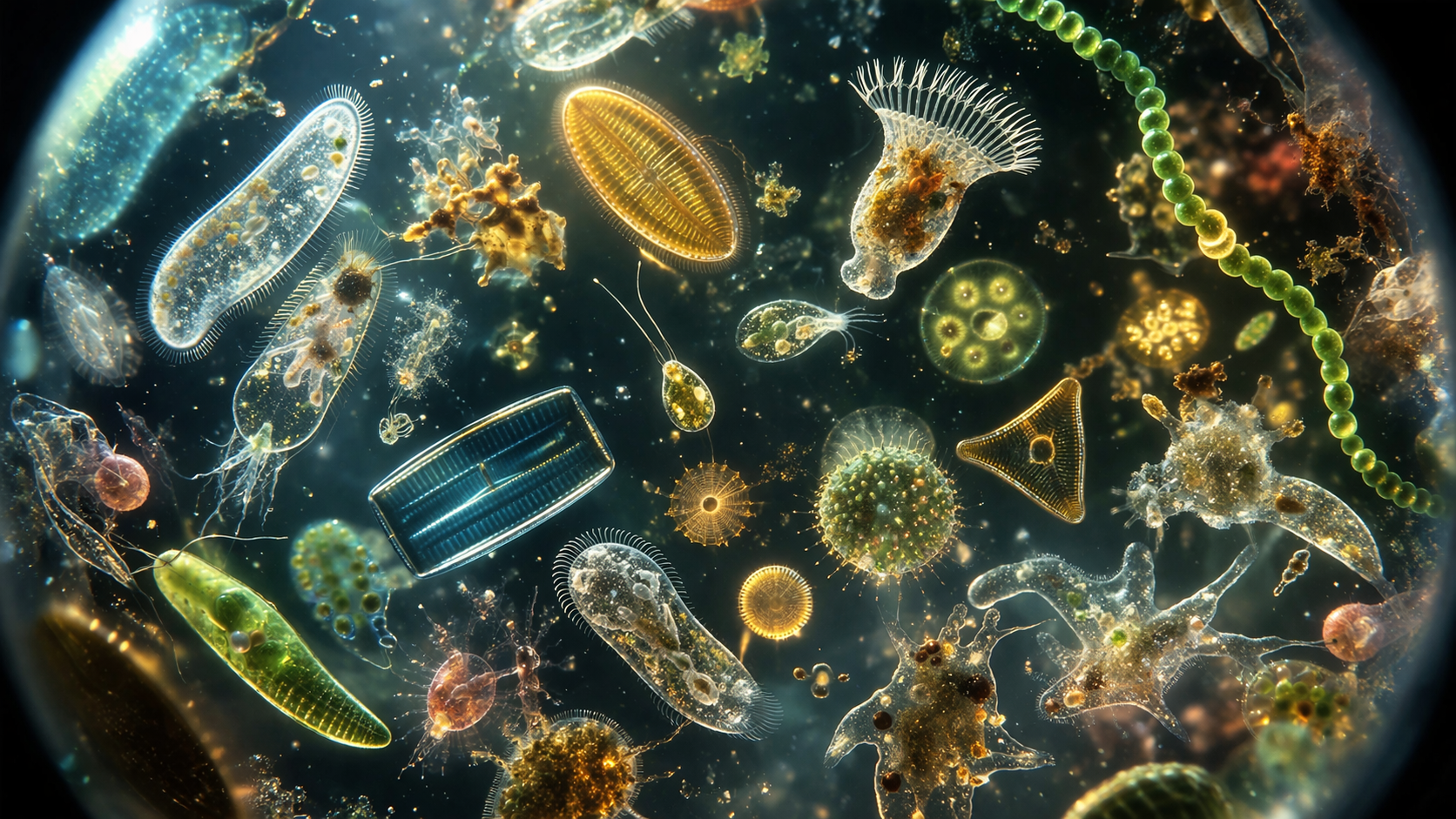
Evolution happens quite slowly in large mammals like humans or elephants, because generations take decades. But it is incredibly fast in bacteria (or even insects), because their generations are orders of magnitude shorter.
Evolution thrives on the rapidity of iteration.
Anyone working on AI should recognize that as a very familiar concept. After all, algorithms are the fastest-iterating mechanisms known. But to date, algorithms and AI have never embraced evolution to its full extent. We've applied natural selection principles in ensemble learning. But selection leads to a form of convergence, where after a while every model looks the same. How to enforce (heritable) variation in that context?
Nature's answer is mutation. The probabilistic deviation from whatever natural selection converged on. Experimentation. In nature, a mutant is unlikely to survive. But sometimes, it hits the right note and gives birth to the future of its species.
At Allora Research, we have discovered that deliberate deviations from optimality across a swarm of agents systematically improve the performance of the swarm, relative to a swarm of optimized models.
We call this principle "Flawed in Nature, Perfect through Evolution".
A single mutant is flawed and doomed to fail, but a swarm of uniquely different mutants maximizes its evolutionary fitness in the face of a constantly changing environment.
The needs of the many outweigh the needs of the few.
I believe the future of AI will be shaped by exactly this principle. We have spent so many resources on building the best individual models, but (as I've said many times) these are no better than interpolation machines. They replicate what they've learned, without shining the guiding light that human pioneers have.
Right now, we're just hoping that AI will bring novelty. And while it can to a limited degree, it's clearly missing something. A spark.
Originality, adaptability, creativity... all of these outshine AI slop any second. And the source of each of these qualities lies in mutation. The deliberate detuning of models away from the optimum.
That is what leads to intelligence. The ability to achieve your goals under any environment.
The missing ingredient in the race to AI has been exactly what the Flawed-in-Nature concept covers. And it was right in front of us, all that time. Because nature already mastered it.
Better stolen well than invented badly.
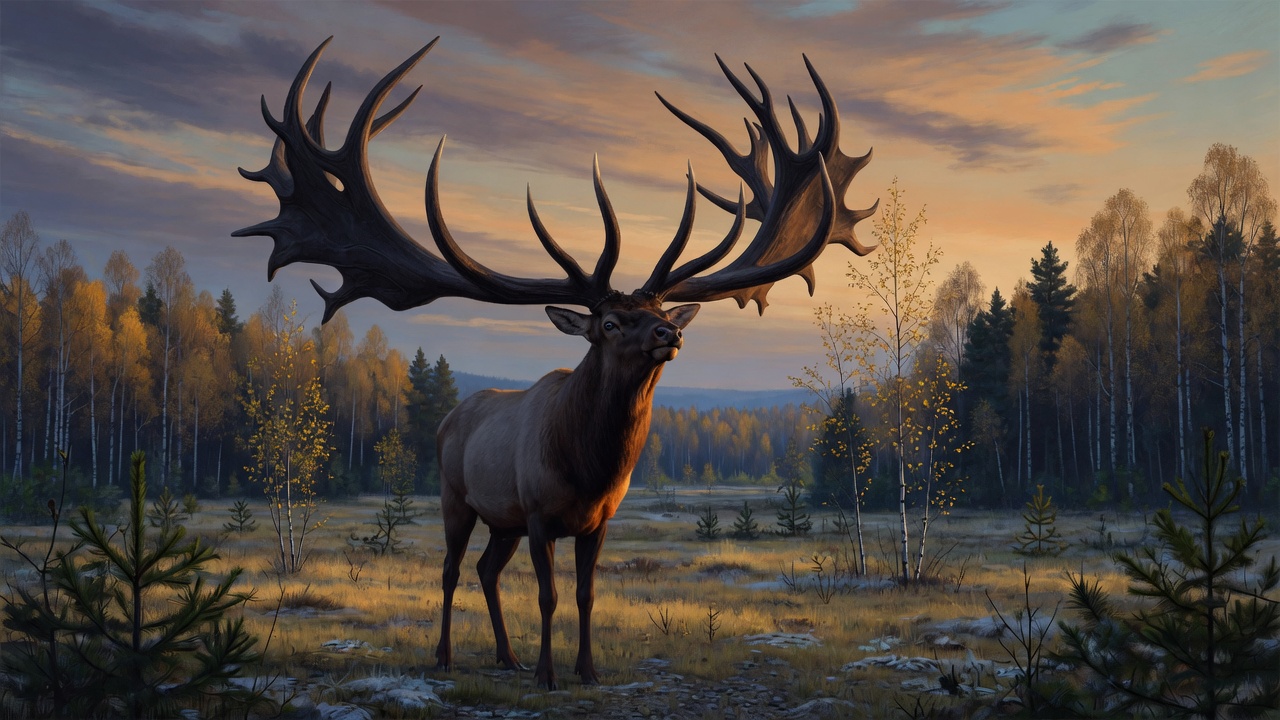
A perfect model meets a moving world
A model trained to be optimal under one set of conditions is, by definition, optimized for those conditions. If the conditions change, the optimum moves with them. But the model doesn't.
This is the part that the Flawed-in-Nature paper formalizes first, before getting to the novel (and more interesting) things. We prove that any single model in a changing environment accumulates error with every shift, and that the error grows linearly with time. No learning rule, no clever architecture, and no amount of fine-tuning can possibly escape this. The model is doing nothing wrong. It's doing exactly what it was trained to do. The world is doing something the model has no information about, and the model has no way of accommodating the surprise.
Real environments do this constantly. Markets shift. Sensors drift. Language evolves. User behavior changes. Regimes flip overnight. Each shift is a moment when the conditions the model was trained on are no longer the conditions it has to operate in. The predictions degrade silently, and the only signal you get is that they stop being as good as they used to be.
The standard reaction is to retrain. Pull in the latest data, re-tune the weights, redeploy. And yes, sometimes this works. But only for a while. Because retraining is always one cycle behind the change, and the next change has no relationship to the last one. You're basically just polishing your rear-view mirror.
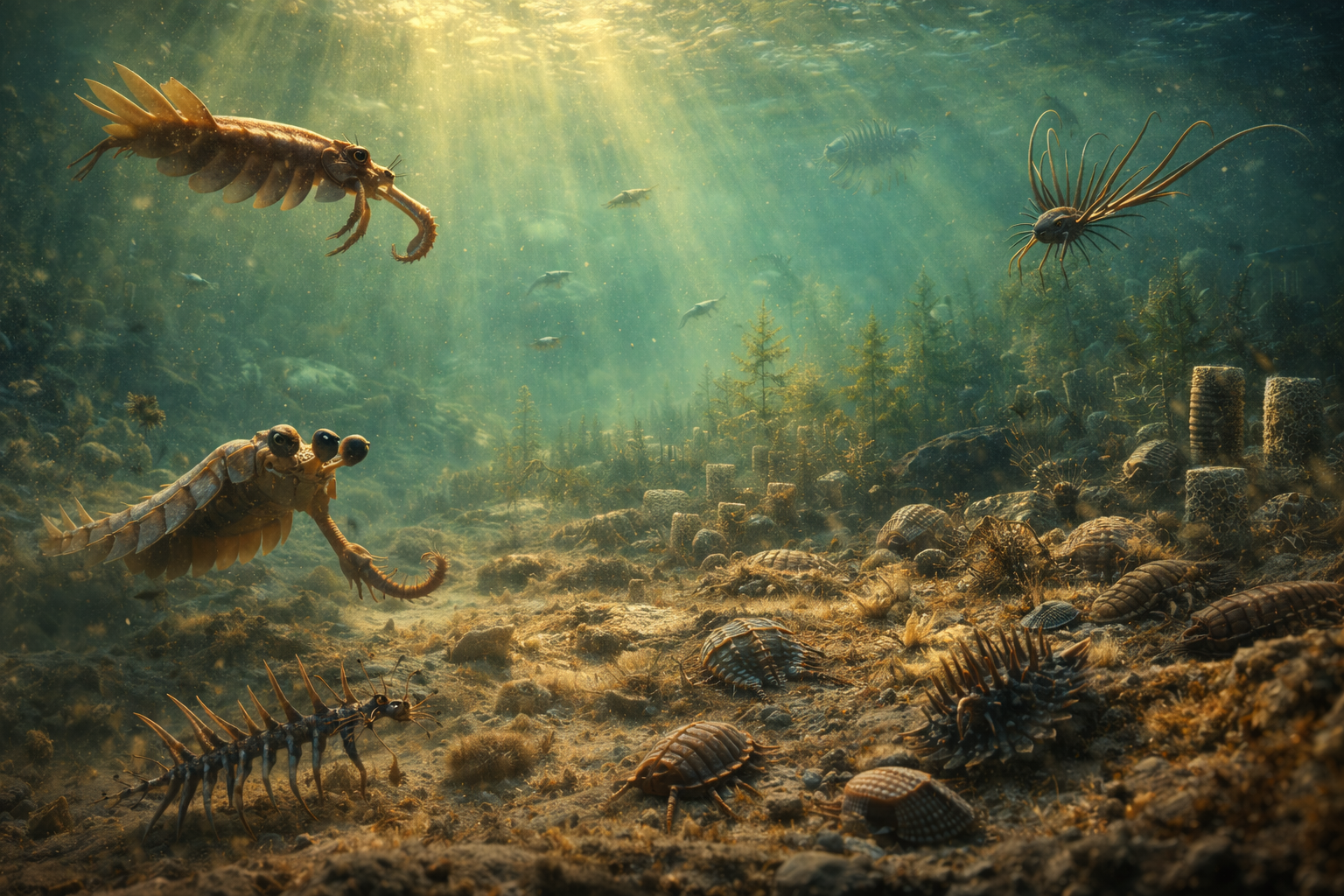
What evolution does instead
Now let's instead look at the example we should be taking inspiration from.
Nature has been solving this problem for about 4 billion years. Whenever an environment changes, a species that was finely tuned to the old conditions faces the same fundamental problem an over-fitted model does. It is optimal for a world that no longer exists. The organisms that thrived yesterday are now mismatched.
But entire species rarely vanish overnight. Most of the time, the species "adapts". It does so by reaching into the variation it has been carrying around all along. There were always slightly different organisms in the population. The environment shifts, and a different subset of them happens to fit the new conditions better. They reproduce more. The center of mass of the population moves.
The unit of adaptation is the species. Populations evolve, but individuals never do. And the speed at which they evolve depends entirely on how much variation the population was already carrying when the environment moved.
England's peppered moths
The textbook example is the peppered moth in 19th-century England. Before the Industrial Revolution, the bark of the trees the moths rested on was light-colored, covered in pale lichens. Light-colored moths blended in. Dark-colored moths got eaten. The population was overwhelmingly light, with a small minority of darker variants that survived only by luck.
Then coal smoke from industrial cities killed off the lichens and coated the bark in soot. Within a few decades, the bark was dark. The mismatch flipped. Now the light moths stood out against the soot, and the dark moths were the ones that blended in. Predation pressure inverted, and within a few generations the dark variant dominated.
The species adapted in decades. By the standards of evolution, that is wildly compressed. It managed this because the dark variants were already there, sitting in the population in small numbers, waiting for the world to need them. If those dark mutants had not existed before the soot arrived, the species would have been in serious trouble.
And that is what really matters. Variation works as a permanent insurance policy, a statistical hedge against an uncertain future. The species pays for it in the currency of slightly suboptimal individuals, long before the environment ever moves. A species without any existing variation is a species betting that nothing will ever change.
The counterintuitive strength of flawed models
In the Flawed-in-Nature paper, we apply that observation to swarm intelligence.
Take a model that has been trained to optimality. Now, instead of just running copies of it, deliberately perturb each copy. Push the parameters away from the optimum, slightly and randomly. You now have a swarm of variants, and every single one of them is worse than the original. If you evaluated them on the conditions they were trained on, they would all underperform.
Intuitively that feels wrong. We have invested years of compute into making models reach that optimum. Why on Earth would you perturb away from it?
Because the optimum is in the past, and the future doesn't care about the past.
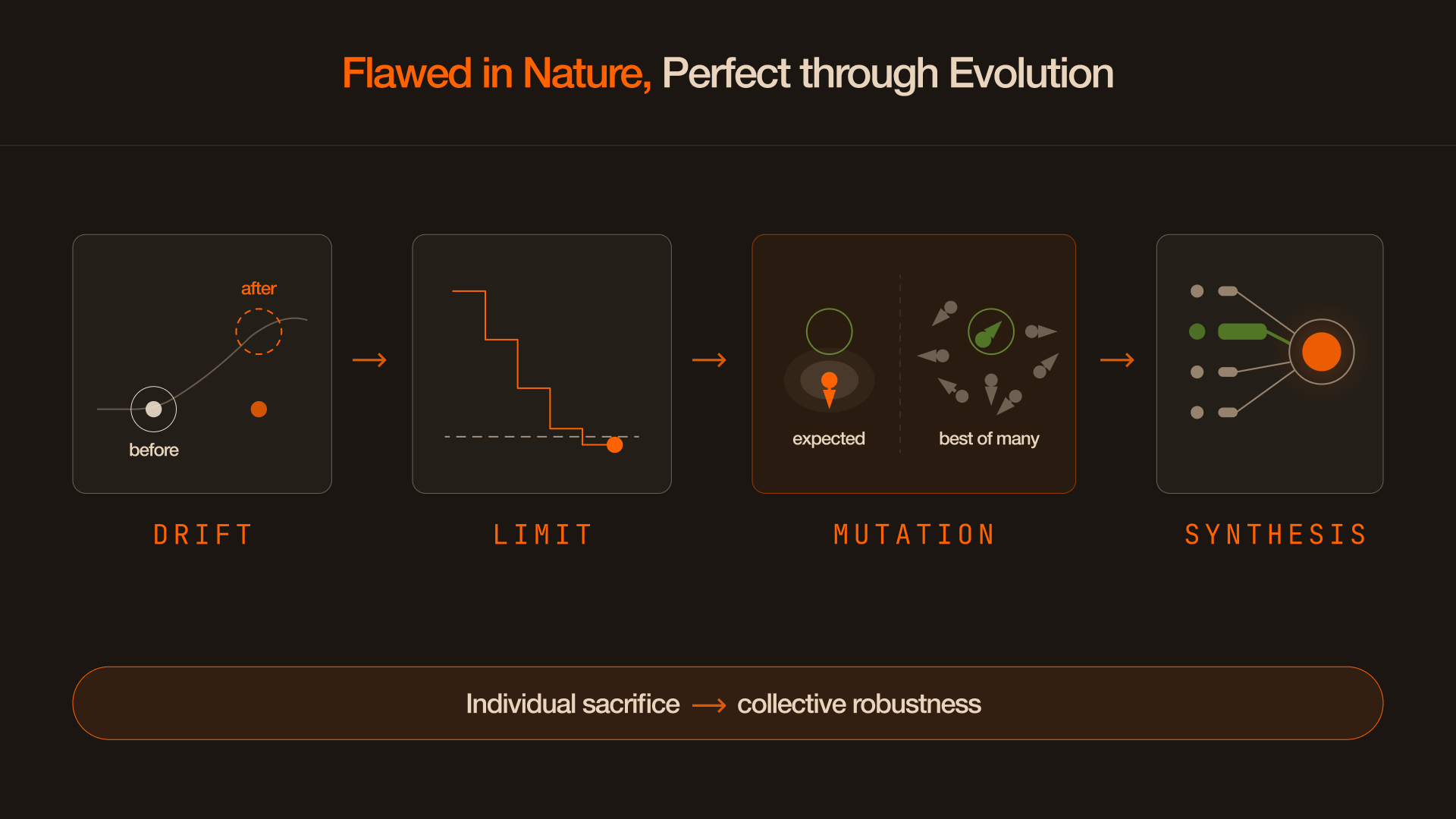
The schematic above visualizes the Flawed-in-Nature mechanism across four panels. First, Drift: the environment moves from "before" to "after" a shift, and the model that was trained on "before" now sits in the wrong place. Second, Limit: a single model's error accumulates across successive shifts of the environment, and its performance is limited by a change-induced ceiling that it cannot break through on its own. Third, Mutation: on average, any mutated copy is worse than the original ("expected"), but the best of many mutated copies often sits closer to the new optimum than the original does ("best of many"). Fourth, Synthesis: a weighting mechanism (this is a selection step, more on it below) concentrates attention on whichever variant is currently performing best, and the swarm's collective output inherits that winner. The tagline at the bottom summarizes the essence: individuals lose, the collective wins.
Each mutated variant is flawed in isolation. The swarm as a whole is better than any single optimized model would have been under the same, changed conditions. The flawed individuals are paying the price of being slightly off, so that the swarm keeps performing when conditions change.
This is exactly the exchange that biology has been making for billions of years. The cost of carrying variation is that most of your individuals are not perfectly adapted right now. The benefit is that you don't go extinct when the world moves.
Does it actually work?
This is a nice story, so let's look at the actual results. The paper formalizes the Flawed-in-Nature idea across four mathematical theorems and a suite of numerical experiments.
The theorems span the end-to-end logical argument. Paraphrasing from the paper, they state:
1. In a world that doesn't change, a single well-trained model converges to the best possible performance. Mutation has nothing to add.
2. In a world that keeps changing, that same single model accumulates error with every shift. The error grows at least linearly with time, and the model eventually becomes obsolete.
3. Even in a changing world, the single model is still doing the best any model can do with only past data to work from. The residual error comes from having no information about how the world may change in the future, and no amount of clever tuning can close it.
4. A swarm of deliberately mutated models achieves strictly smaller error than any single model can. The variation gives the swarm a chance of sitting close to the new optimum after each shift, and that chance breaks the linear error growth that constrains every single model.
We provide formal mathematical proofs in the paper.
We then illustrate the theorems using an experimental setup that's intentionally simple. A toy environment of which the underlying structure shifts unpredictably at random moments. Two swarms of models attempt to make predictions: an original swarm of 32 optimized models, and a mutated swarm of the same size, where the parameters have been deliberately perturbed away from optimality. Both swarms see the same environment, the same shifts, and the same data. The only difference is that one of them is subjected to mutations in its model coefficients.
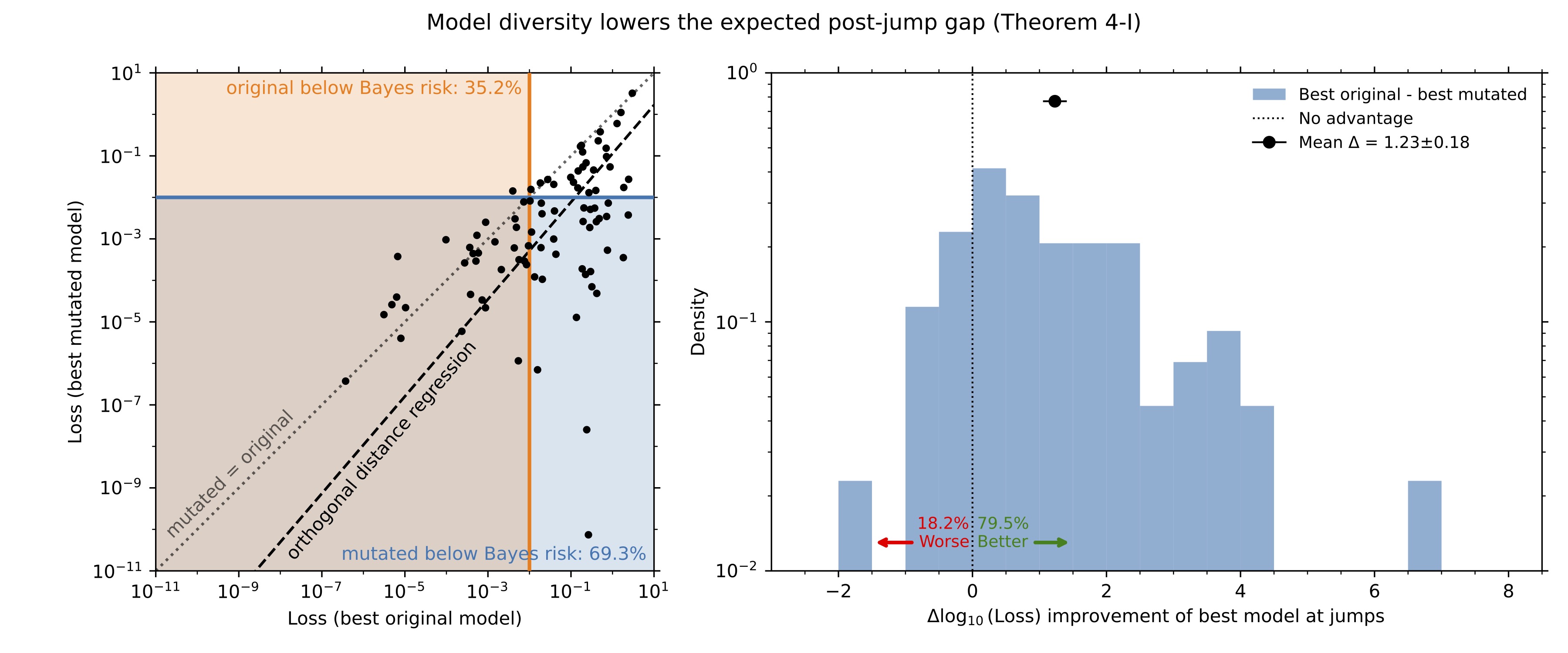
The first result is simple. When the environment jumps, we ask in which swarm the best-performing model lives. The answer is the mutated swarm, in about 80% of the cases. About 4 jumps out of 5, the swarm carrying deliberate variation has at least one variant sitting closer to the new conditions than anything in the optimized swarm. The remaining 1 in 5 is noise (sometimes the optimized swarm just gets lucky), and the asymmetry is the signal.
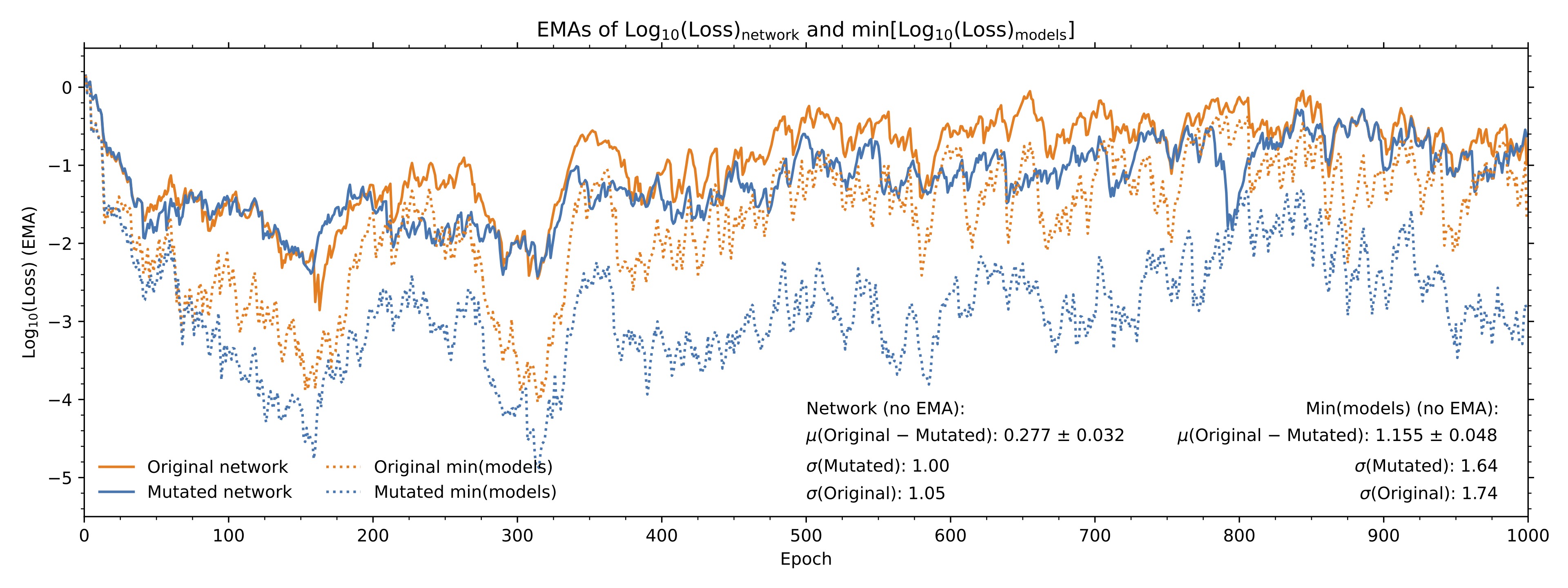
The second result is about cumulative behavior across the full simulation. We track the running average of the prediction error for both swarms over time. After a brief warm-up, the two trajectories cleanly separate, and the mutated swarm's average error stays systematically lower than the original's. The gap is statistically significant at the 8.6 sigma level. This is not noise.
The result holds whichever way you look at it. The best model is better in the mutated swarm. The collective output is better in the mutated swarm. The variance in performance across the swarm is higher (which is the cost of carrying variation), but the synthesized output is more stable. Mutation pays off.
How the swarm picks the winner
There's a second ingredient to natural evolution that we haven't discussed in detail yet, and it's the mechanism that actually realizes the benefits of variation. On its own, variation is just noise. You need natural selection to convert that noise into adaptation.
In biology, selection is brutal. Organisms that fit the current environment leave more offspring, and the next generation is biased toward whatever was working. The mechanism doesn't need to be predictive, it just needs enough variation in the population and the environment does the rest.
Ensemble methods in machine learning have used weighting or direct selection schemes to address this problem. Likewise, the Allora network has the analogous machinery in place. It's called inference synthesis, and it fulfils exactly the same role as natural selection in evolution. When a swarm of models produces predictions, the network observes which predictions have been close to the truth recently, and concentrates its weight on those that are expected to perform well right now. Models that are mismatched to current conditions are quietly de-weighted, and models that are well-matched are amplified. The collective output of the network is dominated by whichever variants are best aligned with the imminent reality.
This is the bridge between biology and architecture. The mutation step generates the variation, and the selection step picks the winners. Variation without selection is noise. Selection without variation is convergence. But together, they are how nature has been optimizing for billions of years. And now the same loop closes inside an AI swarm.
The Goldilocks zone
So now we want to mutate our models. But how often and how far should they mutate?
If you mutate your models too slowly, the variants you generate will all sit close to the original, and when the environment moves, none of them will be meaningfully closer to the right neighborhood. Your swarm is effectively just one model with cosmetic variation. The swarm won't have gotten worse, but it won't have improved either.
If you mutate them too fast, you scatter so far from any plausible optimum that you can't accumulate the small advantages you'd otherwise inherit. You're constantly throwing away whatever just worked. The swarm overshoots.
In between, there's a regime where the rate at which the swarm generates new variation roughly matches the rate at which the environment is changing. That's the sweet spot.
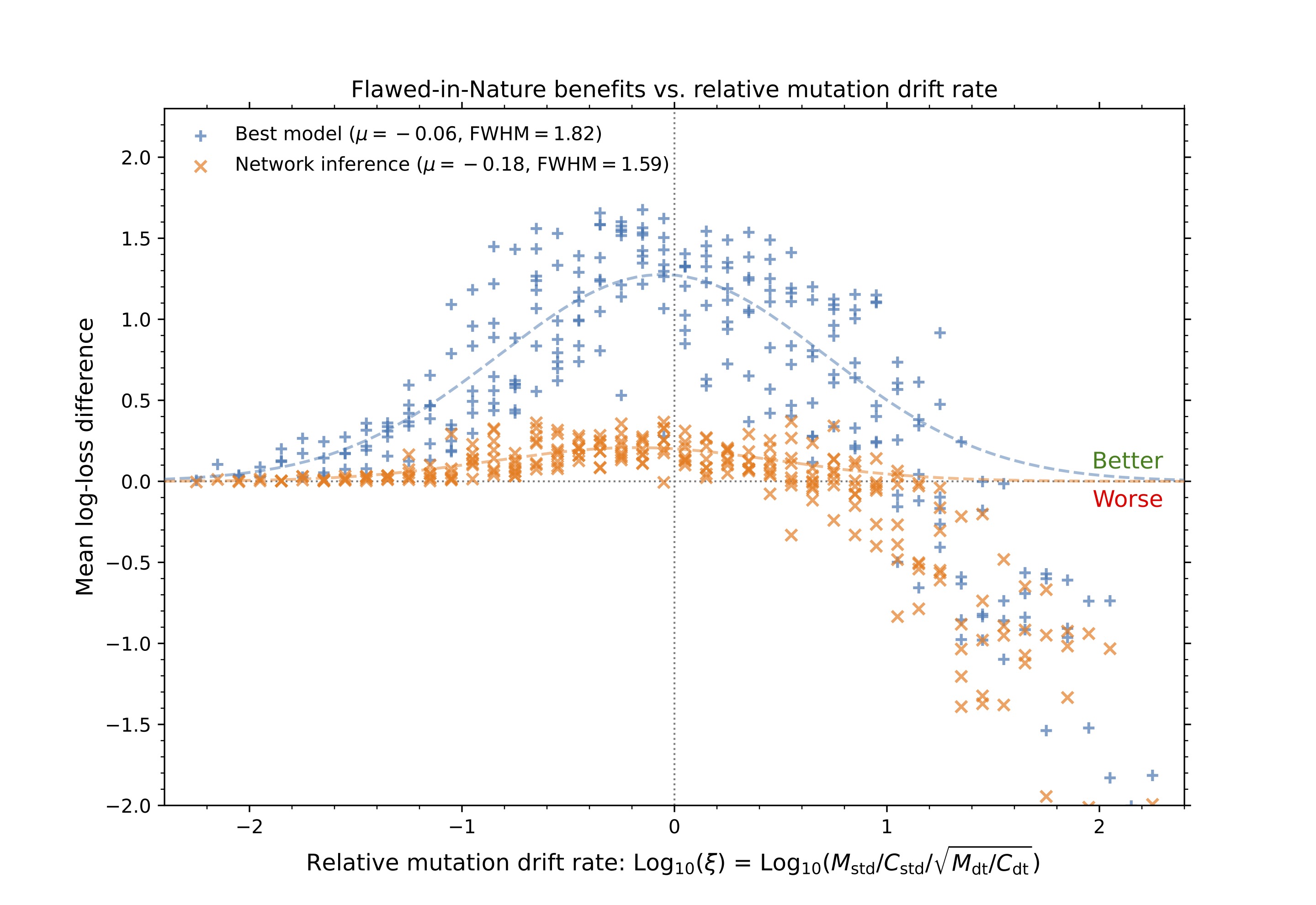
The figure above collapses the full 2D parameter sweep of mutation rate and magnitude onto a single axis: the relative mutation drift rate, which reflects how fast the swarm generates new variation through mutation compared to how fast the environment is changing. The improvement of the mutated swarm over the original swarm peaks neatly where these two rates match.
This is not a coincidence. It's the same balance that governs biological evolution. Bacteria have generations measured in hours, so variation accumulates fast enough for antibiotic resistance to emerge within days. Mammals have generations measured in years, so the same variation takes decades or longer to build up. Generation length sets how fast a species can adapt to a shifting optimum, and natural systems are tuned (over very long timescales) to roughly the right tempo.
The encouraging part of the figure is that the optimum is broad. The advantage doesn't collapse the moment you misspecify the mutation rate. You have nearly two orders of magnitude of slack around the peak. We also see that the falloff is asymmetric, which I expressed above already. Undershooting is gentle. Overshooting is sharp. Be conservative and you'll be fine, because you default back to what worked in the past. But be reckless and the swarm will overshoot before it can find the new optimum.
The biological analogy is striking. A slow-mutating species still has what worked in the past, and only fails if environmental change exceeds the variation it can generate. A fast-mutating species loses what worked irrespective of whether the environment changed.
Where Flawed-in-Nature could lead us
Flawed-in-Nature is a design principle for multi-model systems. The paper makes no commitment to running it inside any specific system. The discussion section sketches several directions where the principle could be applied.
The most direct application is to classical ensemble methods. These already generate diversity through random initialization, hyperparameter variation, or independent fine-tuning runs. But none of them involve deliberate, cumulative parameter mutations. Adding that as a post-training step gives the ensemble a new source of diversity that is specifically useful when the environment is non-stationary. The same logic extends to reinforcement learning, where population-based methods typically mutate hyperparameters rather than model parameters directly.
A potential use case that intrigues me is large language models (LLMs). The environment that an LLM operates in is inherently non-stationary: language drifts, knowledge emerges, user preferences shift, and retraining the base model on every new signal is prohibitively expensive. Parameter-efficient fine-tuning methods like LoRA adapters could act as a low-dimensional mutation layer on top of a shared base model, which would make it computationally feasible to maintain a swarm of deliberately diversified variants. Whether LoRA's low-rank constraint provides enough coverage of the relevant parameter directions is an important open question.
Decentralized AI is a more complicated case. A network of independent model providers represents a heterogeneous population, which is the structural ingredient that Flawed-in-Nature needs. But the network cannot dictate mutations to its participants, because independent operators control their own models. Making it work in a decentralized setting would require designing incentives that reward contributions to the swarm's collective adaptability rather than to any individual model's accuracy. That is a hard research problem, and the paper flags it as future work.
Of course, none of these are promises. But they are concrete directions opened up by this novel mechanism. If you are interested, the full math is in the paper, including the four theorems that determine why a single model's error grows without bound under unpredictable change, and why a mutating swarm escapes the same fate.
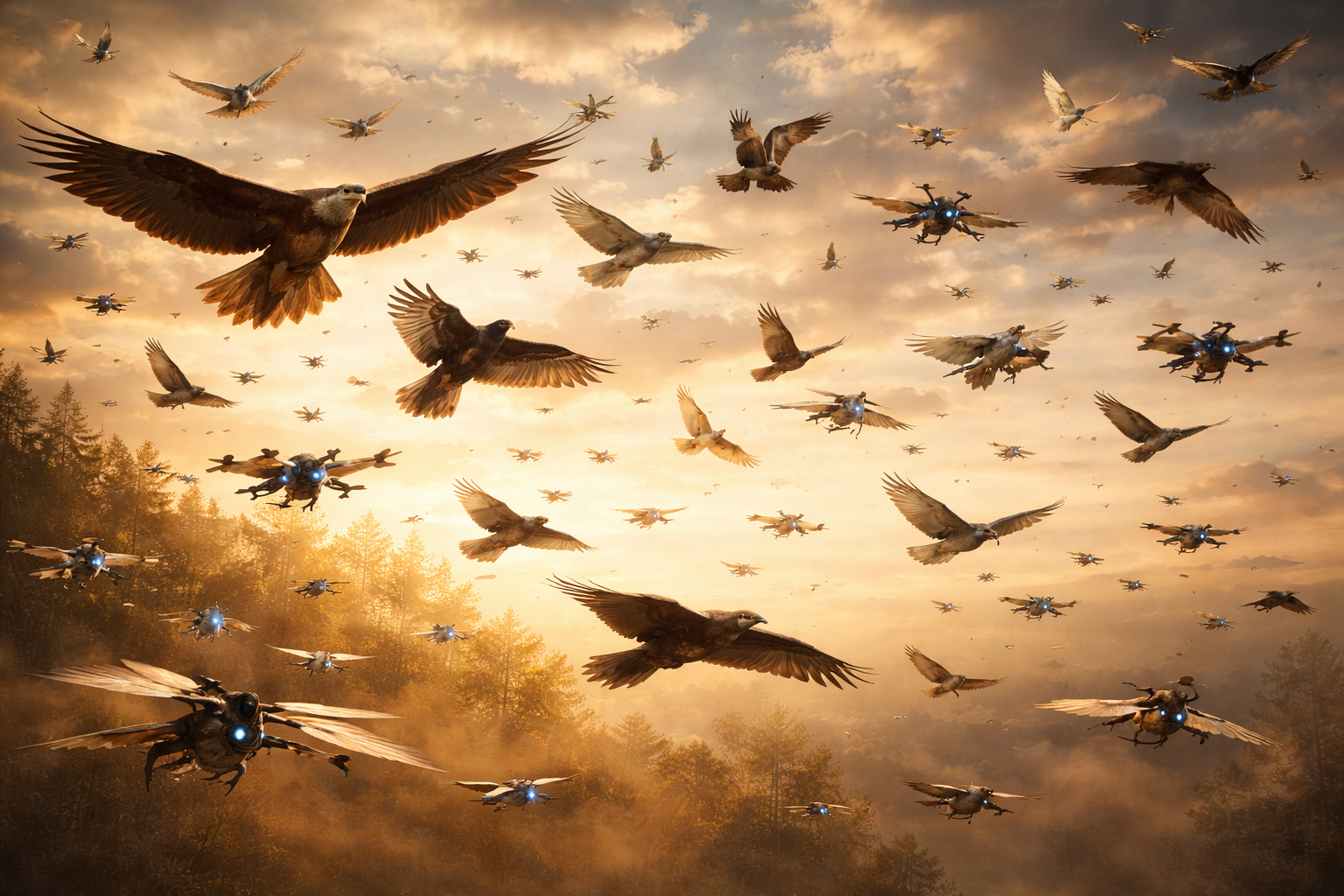
What happened to life will happen to technology
The idea that individual imperfection can yield collective perfection is the essence of the Flawed-in-Nature principle. It reimagines how (artificial) intelligence might originate.
The use of random mutation as a form of experimentation in the face of an uncertain future closely resembles the evolutionary path through which biological intelligence likely arose. After all, when an organism achieves high fitness under natural selection, the mutation that granted it that fitness took place long before the selection event. Nature too performs statistical hedging.
Current discussions in AI research often revolve around the question which ingredients are still lacking in frontier AI systems. I believe that it is not a specific ingredient that has been missing, but a process. Based on its close analogy to biological evolution, it is not unthinkable that the Flawed-in-Nature mechanism could enable the organic discovery of forms of machine intelligence that more closely mimic biological intelligence.
"The future of AI is decentralized swarm intelligence.
No omniscient monoliths; countless independent models.
Many specialized, some general. They will evolve. They will mutate. There will be lineages of models. What happened to life will happen to technology. But much faster."
And now we've proven that the underlying principles indeed work. I deeply appreciate nature for lending us the idea. We can be pretty sure it wasn't invented badly.
—
Interested in learning more? Read the full research paper in Allora Decentrized Intelligence.
Want to share your thoughts? Join the discussion on the Allora Research Forum.
About Allora Labs
Allora Labs is the main developing contributor to the Allora Network, a decentralized AI inference network. Allora Labs conducts research in swarm intelligence, model coordination, and inference synthesis.
About Allora Decentralized Intelligence
Allora Decentralized Intelligence (ADI) is a scholarly research journal publishing innovation in decentralized machine intelligence, model coordination, and swarm intelligence.