Every enterprise buying AI today faces the same uncomfortable dependency. The intelligence that increasingly drives pricing, risk, forecasting, and operations sits inside a handful of closed models owned by a handful of vendors. You cannot see how the output was produced. You cannot verify it. You cannot easily swap it. And when that single provider changes its terms, its weights, or its availability, your business inherits the risk.
For regulated industries, sovereign infrastructure operators, and large cloud and telecom players, that is not a comfortable position. They want AI intelligence that is reliable, neutral, and verifiable, and they increasingly want a decentralized or auditable option rather than a black box under someone else's control.
This is the gap Allora is built to fill. Allora is the leading Model Coordination Network (MCN), a decentralized AI network that coordinates many specialized machine-learning models around a shared objective, weighting them in real time and aggregating their output into a single forecast that consistently beats any one model on its own. It produces forward-looking inference that applications consume via API or onchain, through a neutral and verifiable network. A neutral, decentralized network is attractive to enterprises precisely because it is not a single-vendor black box.
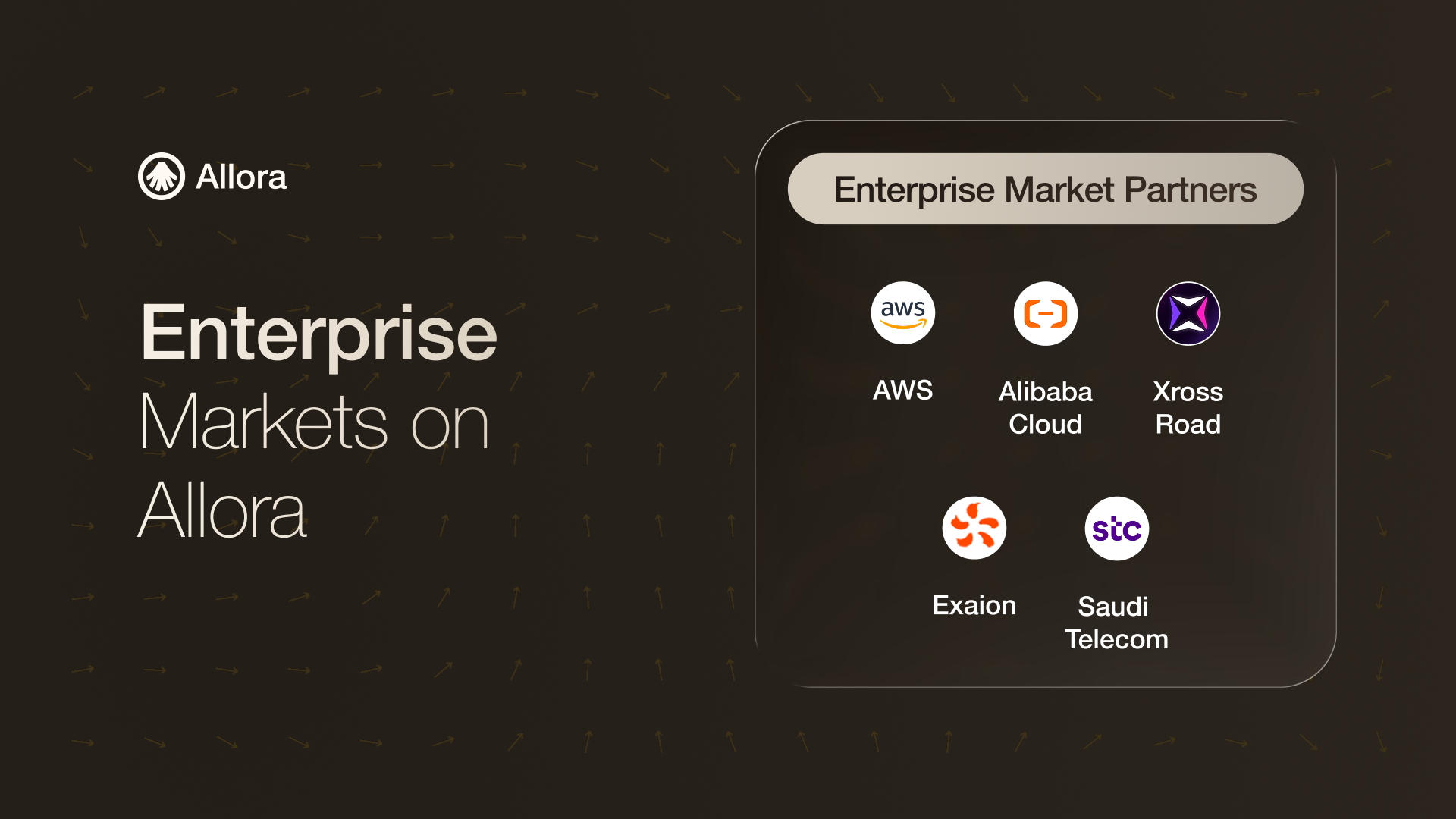
The enterprise segment of the Allora ecosystem reflects that pull. The names associated with it are among the largest infrastructure and connectivity operators in the world: Amazon Web Services, Alibaba Cloud, Saudi Telecom (stc), Exaion, and Xross Road. Together they represent global cloud capacity, national digital infrastructure, and specialized compute at a scale few networks can claim proximity to.
Where Enterprise AI meets a neutral network
Alibaba Cloud is the cloud and AI arm of Alibaba and one of the largest cloud providers in the world, with deep infrastructure across Asia and beyond. Public Allora communications describe a collaboration with Alibaba Cloud around launching an S&P 500 prediction topic on the network. At the level the public record supports, this positions Alibaba Cloud as an infrastructure and go-to-market participant rather than a defined product integration.
Amazon Web Services (AWS) is the largest cloud platform globally and appears in the enterprise segment of the Allora ecosystem map. AWS is the default deployment environment for a large share of AI workloads, so its presence signals where Allora-connected builders run infrastructure.
Saudi Telecom (stc) is the Kingdom's largest telecom operator and a major digital infrastructure company, expanding aggressively into cloud, sovereign AI, data centers, and enterprise services under Saudi Arabia's Vision 2030. stc appears among the enterprises named as engaged with Allora. For a national operator building sovereign AI capacity, a neutral network that can be independently verified is a natural fit.
Exaion, historically a subsidiary of the French energy utility EDF, operates high-performance computing and secure cloud and AI infrastructure across Europe and Canada. Exaion is named among the infrastructure players engaged with Allora, aligning with its focus on secure, sovereign compute for AI workloads.
Xross Road is a Japan-based Web3 platform focused on intellectual property incubation and fan engagement. Its publicly announced partnership with Allora centers on AI and IP solutions: data analysis to enhance IP markets, customized user experiences, and detecting IP misuse. It sits on the enterprise map more as a regional platform partner than a core infrastructure provider.
What Allora gives an enterprise
The enterprise problem is dependency without verifiability. A single closed model is opaque, non-neutral, and impossible to audit, yet it may sit at the center of decisions the business is accountable for.
Allora supplies neutral, adaptive intelligence in place of that dependency. Because it coordinates many competing models and weights them by demonstrated accuracy, no single vendor controls the output, and the aggregate consistently outperforms any individual model. The result is inference an enterprise can consume via API or onchain, from a network whose behavior can be inspected rather than taken on trust.
For infrastructure operators, that is the strategic point. Allora is an open intelligence layer they can tap, extend, and build on, rather than a product they must accept as-is. As enterprises look for AI they can verify and govern, a neutral network becomes infrastructure, not just a vendor.
Sources
- https://thedefiant.io/news/press-releases/allora-foundation-announces-launch-of-allora-mainnet-and-allo-token
- https://www.allora.network/blog
- https://hackernoon.com/xrossroad-announces-strategic-partnership-with-allora-network-to-expand-japanese-ip-in-web3
- https://www.edf.fr/en/pulse/ventures-portfolio-exaion
- https://vision2030.ai/institutions/stc/