Every DeFi protocol that manages capital is, underneath, a forecasting machine. A concentrated liquidity vault has to guess where price will trade before it repositions its range. A yield strategy has to guess which pool or leverage level will pay best over the next few hours. A lending vault has to guess when volatility will spike so it can de-risk before liquidations cascade. These are predictions, whether or not the protocol admits it.
The problem is that most of DeFi makes these calls on static rules or lagging data. A rebalance triggers after price has already moved. A range widens after fees have already leaked. A vault de-levers after the drawdown, not before it. The intelligence arrives one step behind the market it is supposed to anticipate.
Allora is the leading Model Coordination Network (MCN), a decentralized AI network that coordinates many specialized machine-learning models around a shared objective, weighting them in real time and aggregating their output into a single forecast that consistently beats any one model on its own. It produces forward-looking inference, including price forecasts, volatility, and risk, that apps and agents consume via API or onchain. In most segments of the ecosystem Allora's forecast informs a decision. In DeFi it is used as the input that directly moves capital: the range, the leverage, the allocation.
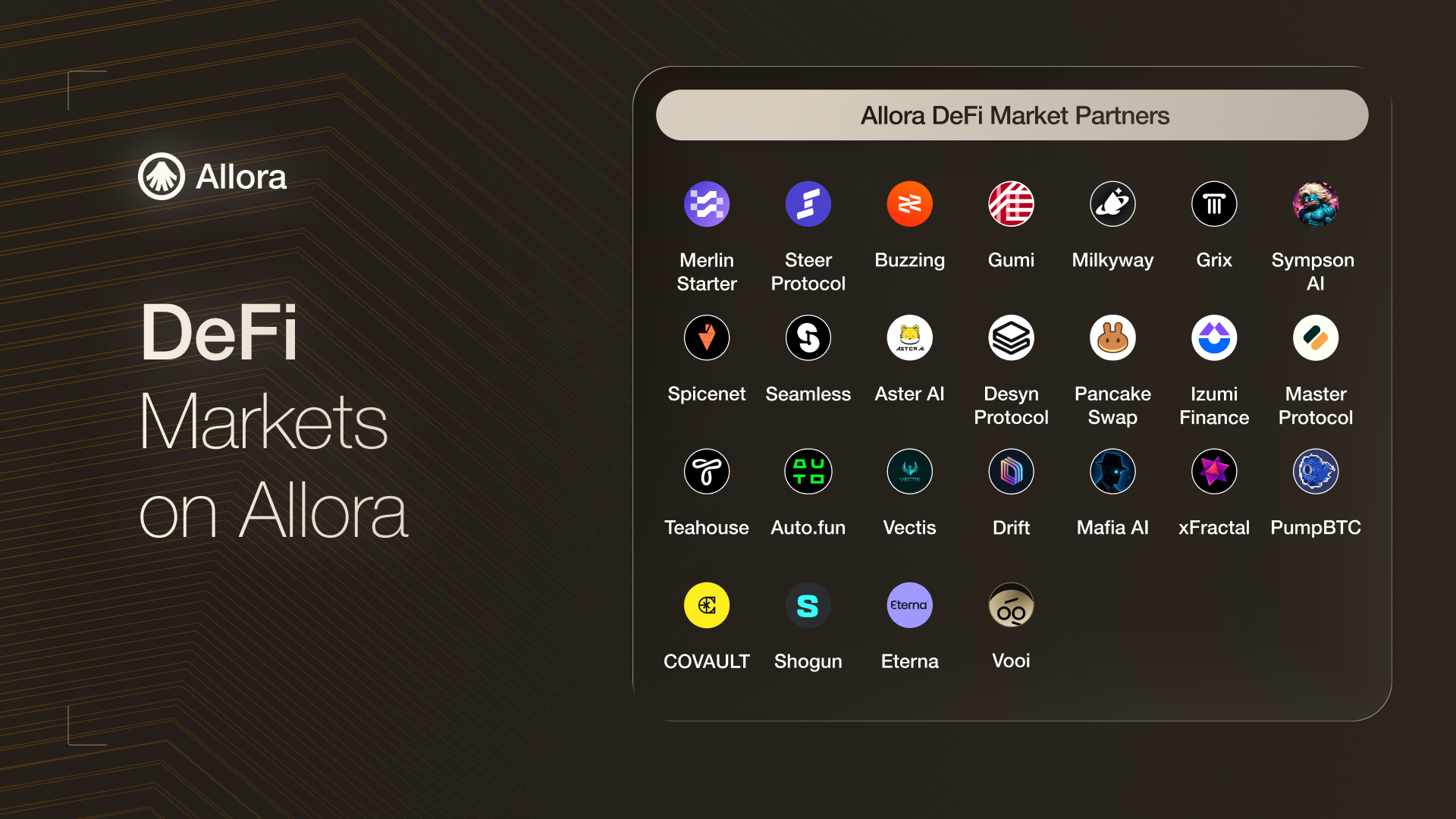
That footprint runs across liquidity managers and vaults, with confirmed integrations at Steer Protocol, Drift, and PancakeSwap, and public integrations at Seamless and iZUMi Finance.
How Allora predictions power and optimize DeFi capital
Steer Protocol runs automated liquidity management for concentrated-liquidity DEXs, and its Allora integration is the clearest example of a forecast doing real work. Steer's AI-powered Smart Pools consume Allora's offchain price prediction feeds to reposition LP ranges before volatility hits rather than after. The goal is to keep LP tokens inside the fee-generating band and shield providers from downside, and the vaults are live across multiple chains, starting with ETH/USD and BTC/USD pairs. This is the ALM use case in production: prediction in, liquidity range out.
Drift is a Solana perps and vault protocol, and its Allora work shows up in intelligent yield. Through RoboNet Finance, an AI-powered looping strategy uses Allora's collective intelligence to adjust leverage, profit-taking, and asset allocation in real time. Instead of looping on fixed parameters, the strategy reads Allora's predictive market intelligence to manage liquidation risk and capital efficiency dynamically, tightening or unwinding leverage as the forecast shifts.
PancakeSwap taps Allora for the intelligence underneath its markets. Its AI-powered prediction market on Arbitrum lets users forecast ETH price with or against an Allora-driven model, and the payout structure adapts to the model's accuracy over time. Here Allora's inference is the reference the entire market prices against.
Seamless pioneers Integrated Liquidity Markets, self-rebalancing vaults that package borrowing and looping into one position. Its published Allora integration is aimed at smarter leverage strategies, using advanced predictions to inform when and how those self-rebalancing vaults adjust exposure.
iZUMi Finance has announced a partnership to harness Allora's AI price predictions to sharpen forecasting, strengthen market insight, and detect trends across its DeFi products, feeding predictive pricing into its liquidity and market-making layer.
The remaining protocols on the DeFi map, including Teahouse, Master Protocol, Desyn, Vectis, COVAULT, Shogun, and others, are natural fits for the same pattern. A vault manager, a structured-product desk, or a liquidity engine all make the exact forecasting decisions Allora is built to serve. Where a public integration is not yet documented, treat the fit as directional rather than shipped.
What Allora gives a DeFi protocol
Your protocol already needs a forecast. Building one in-house means hiring ML talent, sourcing clean data, training models, fighting decay, and defending the whole pipeline as a single point of failure. Most teams cannot justify that, so they settle for rules that lag the market.
Allora hands you the output without the overhead. You request an inference, a price forecast, a volatility read, a risk score, and route it straight into the decision your contract already makes: when to reposition a range, how much leverage to carry, which pool to allocate to. The heavy lifting of coordinating and weighting the underlying models happens inside the network.
Because that output is model-agnostic and available via API or onchain, Allora sits as a neutral open layer beneath DeFi. It does not compete with your vault or your DEX. It supplies the forward-looking intelligence they all quietly depend on, and lets the best models, not the loudest, decide what the forecast says.
Sources
- https://www.steer.finance/integration/allora-network
- https://www.allora.network/blog/steer-and-allora-advancing-liquidity-management-with-ai-precision
- https://www.allora.network/blog/drift-x-allora-ai-powered-looping-strategy
- https://www.allora.network/blog/pancakeswap-and-allora-collaborate-to-create-ai-powered-prediction-markets-on-arbitrum-6e148
- https://docs.pancakeswap.finance/play/prediction/ai-prediction
- https://www.allora.network/blog/allora-seamless-enabling-smarter-leverage-strategies
- https://medium.com/@izumi-finance/partnership-announcement-with-allora-leveraging-ai-to-empower-izumi-01c45d4df805